Full article


Out-of-hours claims overflow is rarely a people problem first. More often, it is a workflow problem wearing a staffing costume. When overnight enquiries stack up, the real question is whether your intake system can separate urgent, viable matters from everything else without collecting too much data, creating compliance risk, or leaving good cases waiting until breakfast.
This is where a structured decision tree earns its keep. Used properly, QuickThought can support legal intake qualification, speed up first response, and create a defensible audit trail without drifting into generated legal advice. The trade-off is straightforward: you give up a bit of conversational looseness in exchange for cleaner routing, better evidence, and fewer expensive blind spots.
Signal baseline
Last Tuesday, in a London intake room, I watched a team work through roughly 200 overnight enquiries before the first coffee had properly landed. Printers humming, paper everywhere, a few sticky notes trying to hold the whole thing together. That’s when I realised the bottleneck was not diligence. It was design.
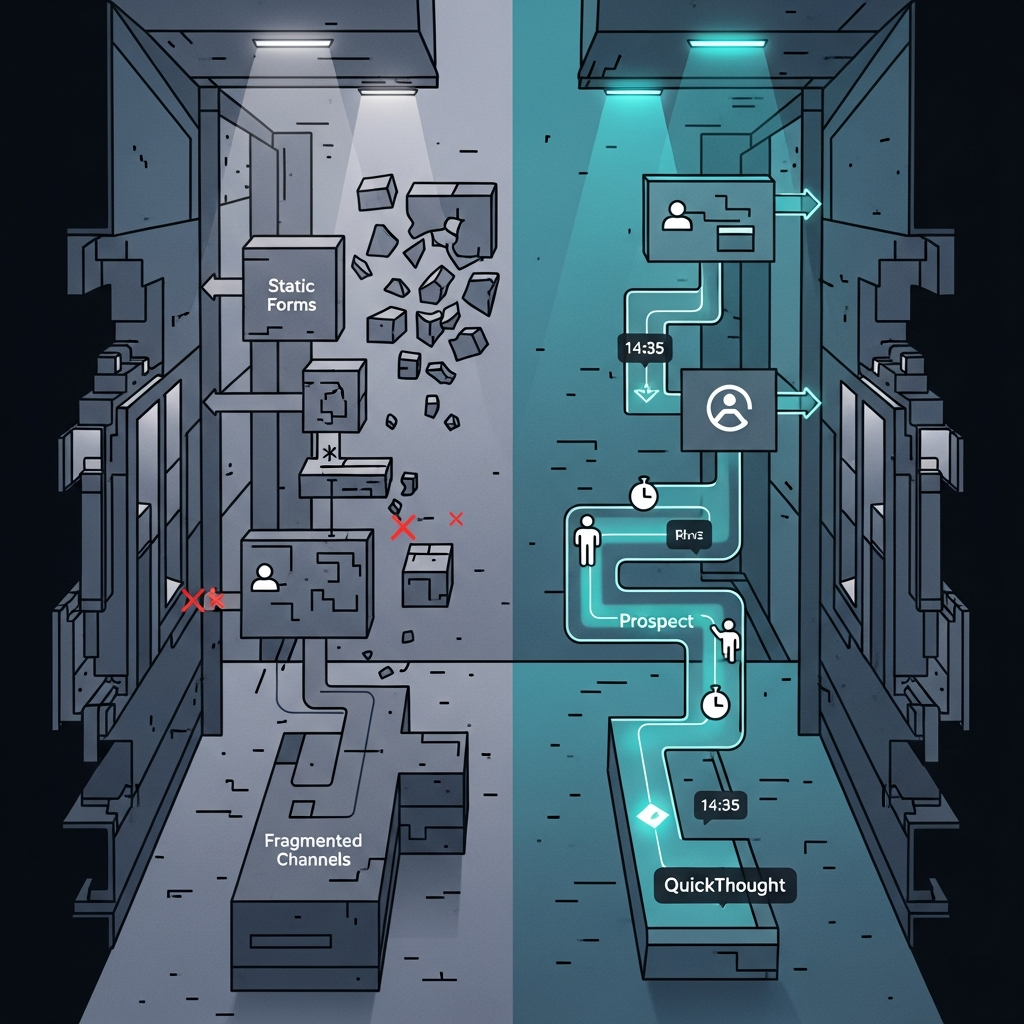
For many UK firms, out-of-hours intake is still a patchwork of email inboxes, web forms and manual triage the next morning. That structure breaks first on speed, then on consistency. If an enquiry sits unread for 72 hours, the issue is not that the team does not care. The issue is that the system has no reliable way to qualify, rank and route volume when nobody is on shift.
There is also a human context worth noting carefully. The Office for National Statistics publishes quarterly personal well-being estimates for the UK and local-authority-level well-being data, including measures such as anxiety and life satisfaction. Those datasets do not prove a direct increase in legal claims, and pretending otherwise would be sloppy. What they do show is a population under uneven pressure, varying by place and period, which helps explain why enquiry patterns can become spiky, urgent and hard to predict. In practice, firms see the operational result: bursts of emotionally charged enquiries arriving at night, over weekends, and after difficult life events.
I have also seen the economic trade-off up close. Hiring extra headcount to cover peaks sounds sensible until you price the quiet periods. A governed intake flow costs effort up front in design and policy review, but it scales better than adding more people to a queue that remains structurally messy.
What is shifting
Client expectations have moved. People now expect a clear next step at 10.30 pm, not a vague promise that someone may look on Monday. Yet a generic chatbot is usually the wrong answer. If it cannot explain why it asked a question, why it routed a case, or why it stopped, it does not deserve your budget.
The useful shift is away from open-ended chat and towards decision-tree qualification. That means a controlled sequence of questions built around policy, practice area and compliance boundaries. In a claims context, that might include jurisdiction, rough incident date, broad claim type, whether representation is already in place, and whether there is a time-sensitive risk. Clean questions. Clear branching. No fishing expedition for personal data.
QuickThought fits this pattern because it is designed for structured, real-time routing rather than improvised advice. That matters in regulated environments. A firm can create one path for personal injury, another for employment disputes, and a separate route for family matters, each with different stop points and escalation rules. The trade-off is that structured flows feel less free-form than chat. Good. In legal intake, freedom without control is often just ambiguity with better branding.
Between January and March 2026, I tried simplifying several intake sequences down to fewer, sharper decision points and removed questions that felt nice to have rather than necessary. One flow initially failed because it asked for too much too early; completion dropped. We fixed it with a simple hack: defer sensitive detail until after route confirmation. Suprisingly, that did more for completion than any amount of polished copy.
I still don’t fully understand why some short flows outperform longer ones by such a margin, but here’s what I’ve observed: when the user can see the logic, drop-off tends to fall. When the platform appears nosy or vague, they leave. Not always. Often enough to matter.
Who is affected
The first impact lands on intake teams and fee earners. If overnight volume is poorly qualified, the morning starts with admin archaeology rather than case assessment. Partners feel it in wasted fee-earner time. Intake leads feel it in queue management. Compliance teams feel it when records are incomplete, inconsistent, or over collected.
Clients feel it too, and more sharply than many firms admit. A person raising an employment dispute at 11 pm does not need a faux-human chatbot trying to sound comforting while asking over complicated questions. They need a clear path: whether the firm can help, what happens next, and what information is genuinely needed now. That is a better experience and a safer one.
Last Wednesday, in a café in Edinburgh, a compliance lead described her existing intake setup as “a problem deferred until audit dayâ€Â. Steam off the coffee, cold at the window, no drama required. She had already tested a basic chatbot and found it asked intrusive questions before establishing whether the matter was even in scope. That is the wrong way round. Data minimisation is not decorative compliance. It is workflow design.
The Solicitors Regulation Authority’s broader expectation around proper records, client care and supervision means digital intake cannot be treated as a marketing side project. It is an operational control point. The trade-off here is plain enough: the more robust the audit trail, the more carefully you need to design question order, retention rules and hand-off points. That takes work. It is still cheaper than explaining an opaque process later.
How the decision-tree pattern works
A solid out-of-hours pattern starts with scope control. The first branch should identify practice area and whether the matter is one the firm actually handles. If not, stop cleanly. No need to hoover up detail. If yes, the next layer qualifies the matter using a small number of operational questions tied to routing rules.
For example, a personal injury path might ask for the broad incident category, whether the event happened in England or Wales, and whether it took place within a relevant time window. An employment path might ask whether the issue concerns dismissal, discrimination or unpaid wages, plus a rough timing marker such as “within the last three months†or “longer agoâ€Â. You are not assessing legal merit at this stage. You are deciding what happens next.
That distinction matters. QuickThought works best when it is used to direct, not to pretend to advise. A well-built tree can route one enquiry to a call-back queue at 9 am, another to a priority review because a limitation risk is flagged, and a third to a polite no-fit outcome with signposting if appropriate. Every branch should be explainable to an internal reviewer. If you cannot explain the route logic in one minute to a compliance lead, the tree is too clever by half.
There is a practical privacy gain here as well. By collecting only what is necessary at first contact, firms reduce exposure under UK GDPR principles while still capturing enough signal to support triage. The trade-off is that some fee earners will ask for more detail sooner. Resist that urge unless there is a genuine operational need. Better first routing beats messy over collection.
Actions and watchpoints
Start with four pieces of groundwork. Map your most common enquiry types. Define the minimum data needed for each route. Set explicit stop rules for vulnerability, complaints language, or sensitive disclosures. Then document the hand-off: who sees what, when, and in which system. Boring? A bit. Essential? Absolutely.
Measure the workflow with numbers that mean something operationally. Time to first meaningful response is one. Completion rate is another. So is the share of enquiries correctly routed first time, by practice area. If a new tree increases completion but sends poor-fit matters to fee earners, that is not success. Automation without measurable uplift is theatre, not strategy.
Watch the trade-off between clarity and depth. Too few questions and the queue downstream becomes expensive. Too many and users vanish before submitting. In most regulated intake journeys, five to eight well-sequenced questions will outperform a sprawling interview. You can always collect richer detail later once the route is confirmed.
Keep one eye on governance. Publish clear privacy information. If any follow-up form collects email addresses for updates or marketing, offer a genuine opt-out and keep the form short. If your workflow links to terms, complaints information or service limitations, make those references visible at the point they matter rather than hiding them in a footer. Compliance and clarity belong in the main experience, not off to the side where nobody sane will look.
And re-check platform rules and internal policy before launch. Digital intake is not static. The copy, branches, retention settings and escalation rules all need periodic review, especially when practice priorities shift or regulatory interpretation changes. A quarterly review cycle is a sensible baseline; monthly checks are better when volumes are volatile.
What good looks like in practice
Good looks calm. A claimant arrives out of hours, answers a short, relevant sequence, understands why each question is being asked, and leaves with a clear expectation of what happens next. Internally, the firm receives a properly tagged enquiry with enough context to act and an audit trail showing how the route was chosen. No magic. Just sound systems work.
That is the bit many teams miss. They go looking for a chatbot personality when what they need is routing discipline. The result is usually expensive fluff sitting on top of a weak intake process. Better to build something narrower, explainable and measurable. Less theatrical. More useful.
If your current out-of-hours journey is creating backlog by breakfast, Holograph can help you design a QuickThought flow that qualifies legal intake cleanly, routes regulated enquiries with less friction, and gives your team evidence rather than guesswork. If you want to see where the queue is really breaking, have a word with Holograph and we’ll map the decision points properly. Cheers, and let’s make the workflow do its share of the work.