Full article
Created by Marc Woodhead · Edited by Marc Woodhead · Reviewed by Marc Woodhead
Brand activations that turn live engagement into loyalty, not just footfallExecutive summary: The old activation playbook, big footfall, pretty set, hope for posts, still gets you photos, but it rarely gets you proof. In 2026, that's a pricey way to rent attention for an afternoon. The stronger experiential marketing trends in the UK are less about spectacle and more about building a fair value exchange: clear consent, useful data, and a sensible route from live moment to loyalty. Take a cue from STMicroelectronics' edge-intelligence microcontroller: process signals close to where behaviour happens, keep it local where possible, and make every interaction count.
Context: When the Photos Fade, What’s Left?
Last Tuesday, in Shoreditch, I walked past the remains of an activation that had plainly done its job for someone's content calendar and not much else. Damp vinyl curling off a hoarding. Petals ground into the pavement. A hashtag trying to look busy after the audience had gone home. That's when I realised, again, that plenty of live work is built for the camera rather than the person standing three feet away in a coat, checking the time.
There's a trade-off here. Big visual theatre can create reach, and sometimes that matters. But if the build is all surface and no follow-through, the audience gives you seconds and the business gets very little back beyond a footfall estimate. For most marketing directors, that is over complicated in the wrong place. You don't need more noise; you need a clean path from encounter to next action.
What Is Changing: From Spectacle to System
The weak model was simple: create an Instagrammable moment, drive queueing, report footfall, move on. It worked when teams could treat live experiences as isolated stunts, but that window is closing. Stakeholders now want a performance wrap that links spend to something beyond crowd density and social chatter.
This isn't a mood shift; it's an operational one. Holograph's own delivery work shows the difference. In our Lucozade Energy AR campaign with ARize, the reported outcome was a 32% sales uplift because the experience tied to product behaviour and retail context, not just novelty. In editorial systems for Boots Magazine, automating repetitive tasks saved up to 90% time and sped transcription 15x. Different formats, same principle: remove friction that doesn't earn its keep, and measure what changes afterwards.
I still don't fully understand why some flashy installations win approval with wafer-thin reporting, but here's what I've observed between 2024 and early 2026: teams are under pressure to prove progression, not just presence. That means tracking opt-in rate, redemption, revisit rate, or loyalty enrolment after the event. Automation without measurable uplift is theatre, not strategy.
The UK context adds another layer. The Office for National Statistics quarterly personal well-being estimates and local authority data remind us that public mood isn't evenly distributed. If you're running a live experience in Manchester, Croydon or Bristol, audience energy isn't a generic average. On a cold March day, in East Sussex this week, temperatures sat around 3°C with haze, a sheltered queue, phone charging, or a quick reward mechanic can outperform a dazzling but baffling demo. Not glamorous, surprisingly effective.
Implications: Loyalty and Live, No Longer Separate
Loyalty and experiential have spent too long in separate departments, which is why so many activations feel like dead ends. The audience has a good ten minutes, maybe scans a code, then disappears into a reporting gap. If the goal is retention, that's a design failure.
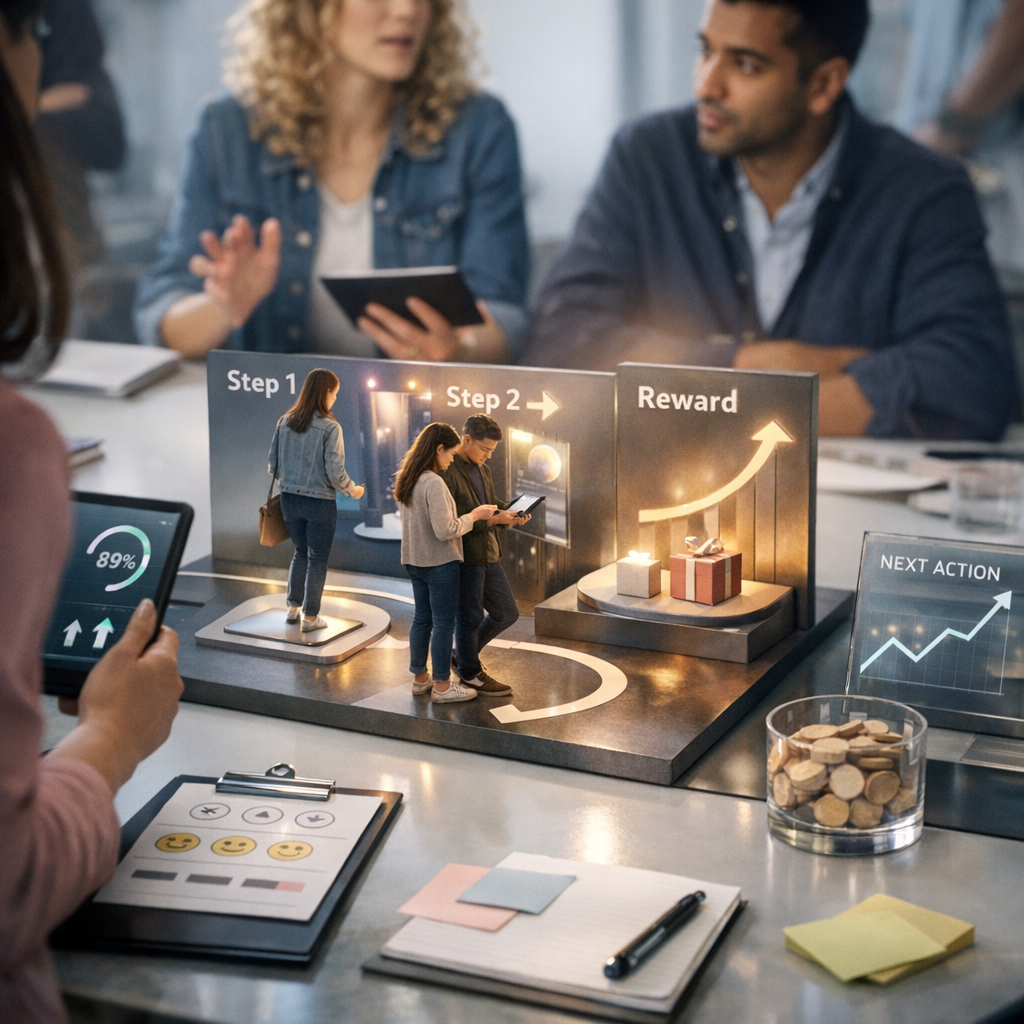
The better approach is to treat the activation as the front door to an ongoing relationship. Make the value exchange obvious in the room: a sample that unlocks tailored follow-up, points for a challenge, or stored preferences with permission. Useful, plain, fair. The trade-off? You might collect less data, but what you get is more accurate and willingly given.
This reframes what people mean by immersive retail experiences. Immersion isn't automatically a headset; it's a joined-up, human journey. Sometimes it's a well-directed staff interaction or a product demo that solves one real question in under two minutes. The system should support the human moment, not compete with it.
Actions to Consider: Build with Edge Thinking
Start close to the behaviour. What does the audience do on site, what signal matters, and what decision needs to happen next? If you can't answer that in one sentence, cut back the concept.
Design the data flow before the hero set. Decide what stays local, what moves to CRM, and what's discarded. In UK activations, especially with family audiences, defaulting to privacy-preserving architecture is good manners and often better conversion. CAP, ASA and GDPR constraints can be creative advantages if you stop treating them as paperwork.
Make measurement brutally specific. Optimise for membership sign-up at 18% of participants, product trial completion above 60%, or reduced queue time. A store manager needs to know if people came back, not a poetic dashboard.
There's always a trade-off. Push personalisation too far and it feels like surveillance; stay too generic and it's forgettable. Better design sits in the middle: enough intelligence to be useful, not enough creepiness to make people step back half a pace.
If a platform can't explain its decisions, it doesn't deserve your budget. That applies to event tech as much as adtech.
If you're weighing how to turn live engagement into something durable, let's pressure-test the mechanics before you commit budget to the wrong bit. Book a chemistry session with the Holograph studio team, and we'll work through the trade-offs, measurement, and build path with you. The aim is simple: create an activation that feels handcrafted on the day and still makes commercial sense a week later.
Proof and original case study
This interpretation draws on a public Holograph case study. For the original source detail, see more Holograph case studies and holograph.digital.