Full article
A voucher promotion can feel tightly controlled while remaining surprisingly easy to game. That contradiction warrants a closer look. A single check, an on-pack code or a basic tick-box declaration, looks neat in a campaign deck because it is simple to explain and light on support overhead. Yet that same simplicity tends to leave brand and fraud teams exposed when duplicate claims or retailer inconsistencies appear.
The more useful comparison is evidence-led proof of purchase versus single-signal checks that are easy to abuse. For UK teams weighing a proof of purchase workflow, the decision is rarely about adding administrative friction. It is about choosing which route protects commercial value earliest without slowing genuine entrants. A strategy that cannot survive contact with operations is not strategy, it is branding copy.
The live decision
The practical choice in UK voucher promotions sits between two opposing routes. Route one relies on a single signal: a standalone receipt upload with minimal data extraction, or an off-platform entry form asking consumers to self-attest their purchase. Route two uses evidence-led proof, tying the claim to multiple artefacts from the same event.
Each mechanic behaves differently under operational pressure. A single-signal process is faster to brief, but it asks the brand to trust an isolated artefact. That works for low-risk promotions with modest value. It becomes hard to defend when voucher value rises, entry volumes spike, or customer support must manage ambiguous edge cases one by one.
When teams test two paths under operational pressure, the single-signal route generates more manual review cases than anticipated. One plan looked strong on paper, then a dependency shifted, and the sequence had to be re-ordered to regain momentum. The support implication for the single-signal route was larger than expected because it left too many unverified cases in manual review. Moving verification upstream solved it before the mess reached dispute handling.
What changes if you wait
Delaying a change to verification rules can look prudent, especially if a current promotion is still converting. However, waiting shifts the cost from campaign setup directly into support and post-campaign explanation. Those costs arrive late, when the team has no room to adjust the mechanic.
Postpone an evidence-led approach and you preserve speed now but accept operational uncertainty later. The real question is whether your promotion can absorb that exposure. If multiple retailers are involved, or if your mechanic depends on user-generated content, the burden of fair entry capture rises rapidly. Platform promotion policies remain volatile and breaches can lead to account action. If your mechanic requires sharing or UGC, design for traceable entry capture. Choose winners fairly, keep the audit evidence, and do not assume a moderation team can sort it out later.
Context matters here. The Office for National Statistics publishes quarterly personal well-being estimates tracking life satisfaction and anxiety across the UK. That is a grounded reminder that consumers already navigate enough daily friction. When a promotion's rules or validation journey feel arbitrary or confusing, people disengage faster than brand teams assume. Best practice is to show the consumer path from entry to claim without hidden steps, using language that communicates fairness rather than theatre.
So what shifts when you delay? Fraud patterns adapt to the easiest signal in your system, and the internal cost of uncertainty increases. The first option looked appealing, but the evidence favoured the second once the numbers landed.
What each route protects or exposes
Not every campaign demands heavy verification. A single-signal model remains an option where the reward is low, the window is short, and the abuse incentive is visibly constrained by physical stock or till data. Growth claims without baseline evidence should be parked until the data catches up. The mistake is not using a simple route; the mistake is deploying it without mapping the commercial exposure.
A single-signal route protects launch speed. What it exposes is proof quality. If a duplicated claim appears, the team lacks the surrounding evidence to distinguish genuine user error from deliberate abuse. That forces manual review, and operational consistency starts to wobble.
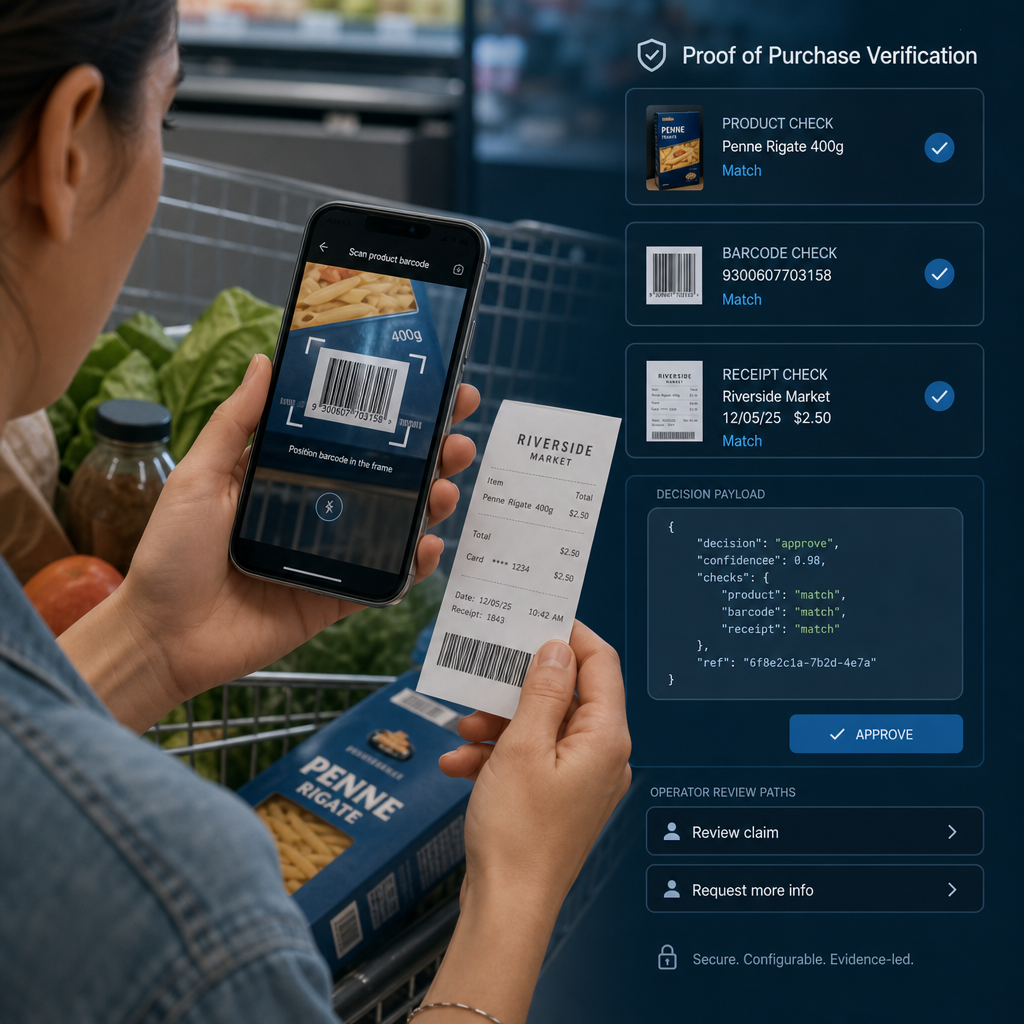
An evidence-led route protects auditability and support capacity. The proof question is whether the claim stays consumer-friendly while the brand still gets strong verification. POPSCAN checks the receipt, product, and barcode together so brands can verify that a real purchase happened without turning the claim journey into admin theatre or slowing genuine consumers down. The claim is approved because the signals agree, drastically reducing room for copied codes or duplicated entries.
That shift has direct consequences for digital voucher security. Linking voucher issuance to a set of matched evidence makes casual replication far more difficult. It also keeps an auditable record of valid entry capture. According to the ONS personal well-being estimates by local authority, baseline satisfaction and consumer mood differ heavily by region. Clear, consistent evidence standards travel far better across varied UK audiences than discretionary support checks that change depending on who answers the ticket.
| Commercial question | Single-signal answer | Evidence-led answer |
|---|---|---|
| How quickly can we launch? | Faster initial setup | Requires deliberate workflow mapping |
| How easily can support resolve disputes? | Harder, often judgement-led | Easier, anchored in matched artefacts |
| How strong is fraud resistance? | Weak to moderate | Stronger, as multiple signals must align |
| How defensible is the mechanic if challenged? | Limited if entry capture is thin | Better if records are complete and auditable |
A defensible next move
The sensible next move is not to over-engineer every digital campaign. It is to benchmark your mechanics against the specific value at risk and the operational drag you are prepared to carry. For most UK campaigns, that means choosing evidence-led proof where voucher value or channel complexity make single-signal checks too easy to abuse.
One unresolved tension remains: the stronger your proof standard, the more carefully you must design for consumer ease. Push too hard on verification and conversion can soften. Stay too light and abuse grows in the background until finance notices. That is the trade-off map, and there is no point dressing it up.
If you need a practical sequence, start with the friction points that create downstream cost. Map exactly where duplicate entries appear and where manual judgement overrides your stated rules. Then test whether combining receipt, pack and barcode evidence would settle those disputes earlier. If it does, move that control upstream. If it does not, do not pretend more complexity will save a weak mechanic.
A calmer, more defensible route is to shift towards evidence-led validation, particularly where measurable promotion fraud prevention is a core requirement rather than an afterthought. If you want to pressure-test which mechanic fits your next promotion, contact the Kosmos team to map your option set, the trade-offs, and a practical launch sequence before the campaign goes live.
A side-by-side trial is often enough to show whether Kosmos is genuinely reducing friction or merely renaming it.