Full article
Created by Brenden O'Sullivan · Edited by Marc Woodhead · Reviewed by Marc Woodhead
When does a receipt upload campaign really start to drift? Usually earlier than the dashboard suggests. Weak claim behaviour often arrives as a pattern of small frictions, like repeated barcode mismatches or crops that trim off the retailer line, long before headline fraud rates look alarming.
Social-led promotions compress attention and widen variance. A campaign can feel healthy on volume while its evidence quality quietly softens. The strategic question is less about catching dramatic spikes and more about seeing weak signals early to protect pace, fairness, and operational cost. For teams using proof of purchase verification, comparing signals in pairs, receipt against barcode, claim velocity against channel behaviour, decides where light controls suffice.
Context
The first surprise in social-led receipt campaigns is that poor claim quality often looks popular, not suspicious. A burst of entries from a creator post lifts participation quickly, but the evidence may be thinner than from owned channels or retailer media. That is an operational fact, not a moral judgement. Different channels teach different habits: a retailer email tends to send consumers into a clear claim path after purchase, while a social post prompts faster action and more partial uploads.
Case comparison helps. Compare two campaigns with similar prize value and effort. In campaigns where the route from entry to claim clearly shows evidence requirements, review work tends to be lower. In others, posts emphasising ease but leaving proof vague typically produce more preventable review. A core promotions principle is that the consumer path should be auditable, with verification steps that feel fair, not hidden.
Operational data shows that looser claim paths often increase starts but raise evidence defects, worsening effective participation quality. A strategy that cannot survive contact with operations is not strategy; it is branding copy.
What is changing
The market shift is a stack of smaller changes that make weak claims easier to produce and harder to classify at speed. Social commerce has shortened the distance between seeing an offer and attempting a claim, while image tools have made receipt manipulation more accessible. The result is a larger middle ground between clearly genuine and clearly invalid submissions.
This middle ground is worth a closer look because it is where cost accumulates. Compare an on-pack promotion driven by in-store intent with a social-led receipt upload. The on-pack route usually benefits from stronger context: the consumer has the pack, the barcode is present, and the claim is close to purchase. A social-led upload can loosen those anchors. Sector-specific patterns emerge, like duplicate receipt patterns in grocery or format variance in fast-growth retail estates.
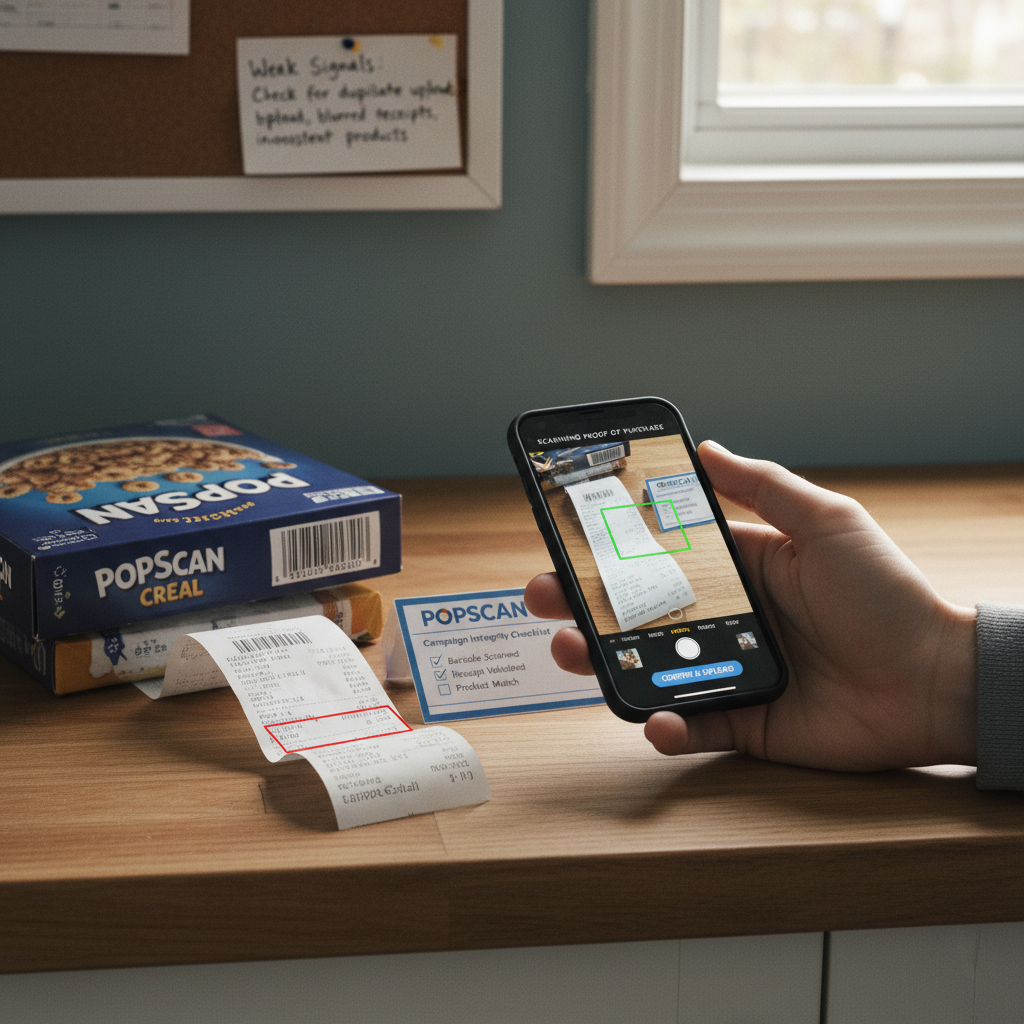
The answer is not to force every claimant through a heavy review. To be fair, that would protect integrity on paper while damaging participation in practice. The better move is paired comparison using barcode and receipt controls as a joined system. If a receipt date aligns but the barcode is absent, the workflow can ask for a corrective step. If the barcode reads cleanly but retailer details are missing, a lighter route may suffice.
Implications
Weak claim signals distort reporting faster than many teams expect. They do not merely raise fraud exposure; a dashboard can show healthy participation growth while manual review queues lengthen and customer support tickets rise. This creates a false sense of success during the very window when corrective action would be cheapest.
Compare two operational responses. The first waits for a visible spike in rejected claims before tightening rules. The second watches early-stage evidence quality, such as barcode readability and receipt completeness, and adjusts prompts within days. The second approach protects campaign pace better because it treats integrity as part of acquisition efficiency, not a back-office task.
This is where promotion participation quality becomes a working measure of whether entries are likely to convert cleanly. Growth claims without baseline evidence should be parked until the data catches up. Integrity rules need to be close to live signals so teams can act before customer operations become the default problem spot.
Actions to consider
The strongest next move is a sequence, not a wholesale rebuild. Start by identifying which proof artefact resolves disputes fastest in your campaign: receipt, product image, or barcode. For many FMCG and retail mechanics, one signal settles uncertainty earlier. Once you know that, shape the workflow around first-clear evidence rather than treating every upload as equally informative.
For POPSCAN users, this often means designing rules in layers. A light layer checks if expected components are present and legible. A second layer compares submissions against campaign conditions, like timing and eligible products. A third layer decides whether to prompt a correction, pass automatically, or route for manual review. The gain is better allocation of human attention and lower risk.
If you are reviewing a social-led receipt campaign, four checks are worth doing this week: compare evidence quality by traffic source; inspect where claims fail first; test if upload instructions match claimant behaviour; and keep the consumer path auditable with visible verification steps.
The point is simple. If your controls rely on the dashboard turning red before anyone acts, the model is late by design. A POPSCAN workflow helps translate weak signals into earlier decisions, protecting both campaign pace and trust. If this sounds familiar, and you want to spot evidence drift before your dashboard has to tell you the hard way, contact the POPSCAN team for a closer look.
If this is on your roadmap, POPSCAN can help you run a controlled pilot, measure the outcome, and scale only when the evidence is clear.