Full article

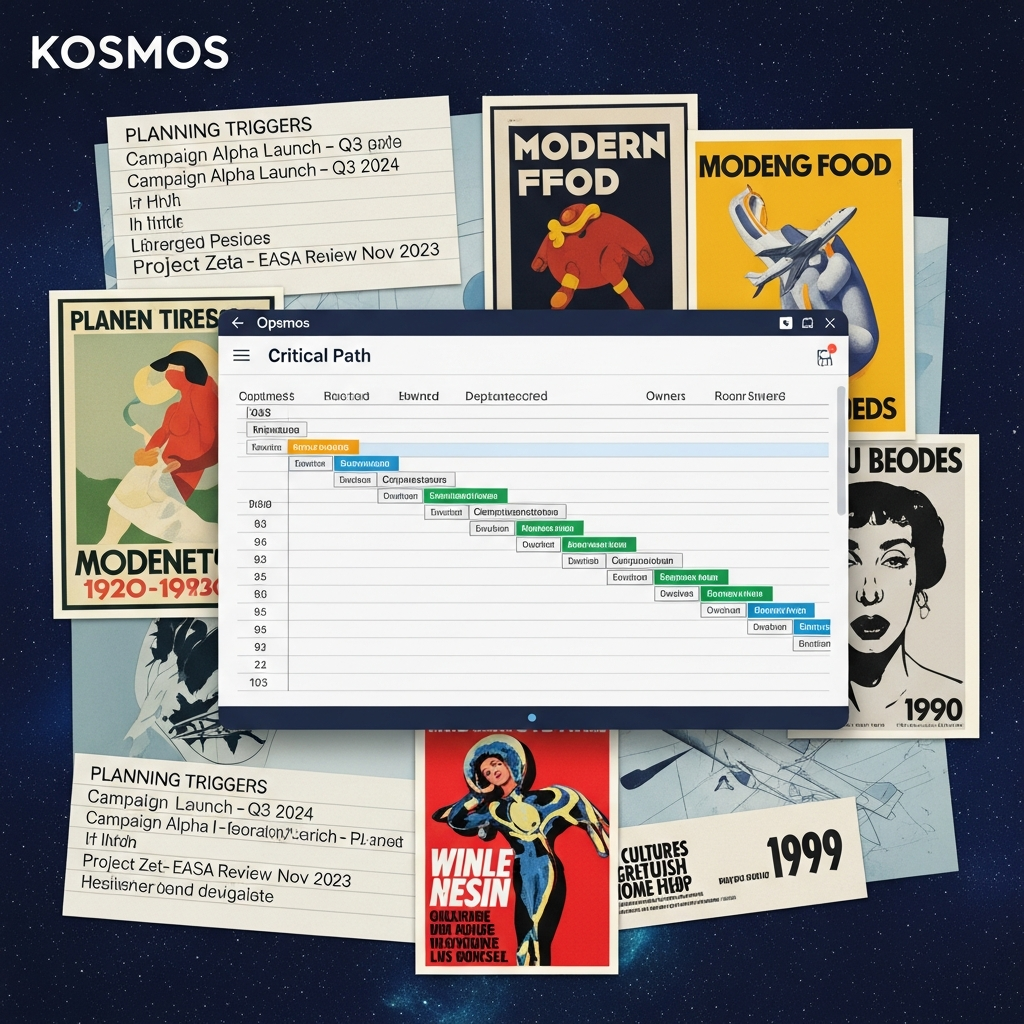
This delivery assurance note covers how an aviation marketing team moved from reactive campaign delivery to a governed plan built around EASA dates. The fix was not more meetings or a prettier brief. It was campaign planning automation with named owners, dated checkpoints, acceptance criteria and a visible path to green.
In practice, that meant pulling external regulatory dates into MAIA on 1 December 2025, creating owned proto-campaigns 180 days out, and measuring whether the new workflow actually reduced churn. By Q1 2026, urgent asset requests had fallen by more than 60%, weekend overtime for planned campaigns had dropped to zero, and three regulated launches landed on time. That is not magic. It is what happens when someone owns the next move and by when.
Situation
In late 2025, the team had a strange problem. Their workload was being shaped by dates that were visible well in advance through EASA communications and event schedules, yet campaign delivery still felt last minute. A regulatory update due in December had been visible months earlier, but the practical work only started once an email was forwarded internally on 15 September 2025. That email became the brief by accident, which is usually where the trouble starts.
The result was familiar enough. Copy reached design before legal had reviewed the claims. David Chen, who led legal and compliance on the account, was brought in too late for a clean first pass. Rework followed. The creative team picked up weekend work to recover the schedule, and sign-off drifted to 8 pm on a Friday, only days before go-live. Bit tight on time is fine once in a while. As a delivery model, it is rubbish.
After a workshop on 4 October 2025, the actual issue was fairly plain. I was wrong about the effort at first, because I thought the briefing quality was the main blocker. It was not. The bigger failure was ownership. No one was responsible for watching external EASA dates, turning them into an internal plan, and making the dependencies visible early enough to act on them. If your plan has no named owners and dates, it is not a plan, fix it.
Approach
We changed the trigger. On 1 December 2025, the team connected public EASA date signals into MAIA so that selected events created a proto-campaign ticket 180 days before the relevant milestone. The rule was simple enough to govern: for event types such as regulatory updates or safety communications, the system generated a planning shell with the source link, event date, campaign category, default owner and initial risk flags. Sarah Jenkins, Senior Campaign Manager, was set as the default owner and had 48 hours to confirm or reassign. That owner checkpoint mattered more than the automation itself.
Each proto-campaign then followed a dated delivery frame with acceptance criteria. The brief and budget checkpoint sat at 150 days out, owned by Sarah Jenkins. Creative concept and messaging framework sat at 120 days, owned by the Creative Lead. Legal review sat at 90 days, owned by David Chen. Asset production completion sat at 45 days, owned by the Production Lead. Final UAT and launch readiness sat at 15 days, back with Sarah. The point was not to force false certainty. It was to make the assumptions testable early, while there was still room to do something useful.
We also tightened the governance around each gate. Legal review did not mean “David has seen itâ€Â. It meant specific acceptance criteria were met, including channel usage, claim substantiation, and where direct outreach was in scope, a check against ICO expectations on direct marketing and preference control. Production complete did not mean “assets existâ€Â. It meant versioned files were approved, channel specs were met, and handoff notes were clear enough for activation without another interpretation round. That is the boring bit people skip. It is also where rework breeds.
There was some pushback. A few people worried that automation would make the process too rigid and squeeze the creative work. I do not buy that. Structure does not kill good ideas. Last-minute churn does. Between 10:00 and 11:30 one Tuesday, I rewrote the acceptance criteria for a partner email story because the consent edge case had not been covered. Tests passed once that edge case was included. No drama, just sorted.
Outcomes
By the end of Q1 2026, the team had run three major EASA-linked campaigns through the new workflow. The operational signals were clear enough to trust. Urgent asset requests, defined internally as turnaround needs inside 48 hours, fell by more than 60% against the 2025 baseline. Weekend overtime for the creative team on those planned campaigns fell to zero. On-time launch performance moved from an estimated 70% in 2025 to 100% across those three Q1 launches.
The quality of cross-functional working improved as well, though I would rather anchor that to behaviour than fluffy sentiment. Legal had context earlier, which meant fewer late-stage reversals. Yesterday, after stand up, ticket EASA-214 was blocked by a partner channel consent dependency. A quick call with David Chen cleared it. New date set for the same afternoon, and the risk log was updated rather than left to memory. That is what a healthier operating model looks like in the wild: faster decisions, cleaner traceability, less heroic nonsense.
There were trade-offs. The planning load moved forward, which meant Sarah spent more time shaping proto-campaigns earlier in the cycle. That is real work, not free efficiency. We also found that a flat 180 day lead time was not right for every event type. Some updates were straightforward; others had awkward dependencies around regional channels, partner approvals or data handling. The mitigation was to keep a change log and review cycle time by campaign type before the end of Q2 2026, rather than pretending one template would fit everything forever.
Risks, controls and the path to green
The main delivery risk was false confidence. Once a ticket exists in a system, teams can assume the plan is handled. It is not. A live plan needs an owner, a date, and acceptance criteria that can fail. To counter that, we set explicit controls: owner confirmation within 48 hours of ticket creation, checkpoint slippage alerts at 7 days, and a weekly RAID review chaired by the campaign owner with production and legal present. If a date moved, the reason and mitigation had to be logged. No silent drift.
A second risk sat around source volatility. Public regulatory calendars can change, and platform promotion rules can move under your feet as well. The mitigation was to treat external feeds as planning triggers, not immutable truth. Source links were stored on each proto-campaign, event details were revalidated at the 150 day brief checkpoint, and channel mechanics were checked again before production lock. That sounds cautious because it is. In regulated work, cautious beats fast and wrong every time.
For teams wanting a practical benchmark, the path to green is not complicated. By the first checkpoint, you should be able to point to the source date, the campaign owner and the launch assumption. By legal review, you should have channel scope, claims and audience handling documented. By production completion, you should have approved assets and a handoff pack that activation can use without another scavenger hunt. If any of those are missing, the plan is amber at best.
Lessons for teams building a campaign operating model
The useful lesson here is not aviation specific. Any team working around fixed external milestones can do this, whether the trigger is an EASA date, an FCA announcement, a budget event or a product release. Start by identifying the external signal that should create work. Then decide who owns the first internal move, by what date, and what must be true at each gate. That is the spine of a decent campaign operating model.
Campaign planning automation helps because it handles the repeatable scaffolding: creating the record, assigning the first owner, attaching the source, setting the dates and surfacing the risk. Humans still need to do the judgement. They decide whether the trigger matters, whether the dates are realistic, and whether a checkpoint is genuinely complete. Good automation reduces ambiguity. It does not replace delivery discipline.
If your team is still relying on forwarded emails, vague deadlines and Friday panic to get regulated campaigns out the door, there is a better way to run it. Holograph helps teams turn messy briefs, brand rules and launch dependencies into an owned workflow with cleaner handoffs and fewer surprises. If that sounds close to home, contact Holograph and we can map your external triggers, owners and checkpoints into a plan that is actually usable. Cheers.
If this is on your roadmap, Holograph can help you run a controlled pilot, measure the outcome, and scale only when the evidence is clear.