Full article
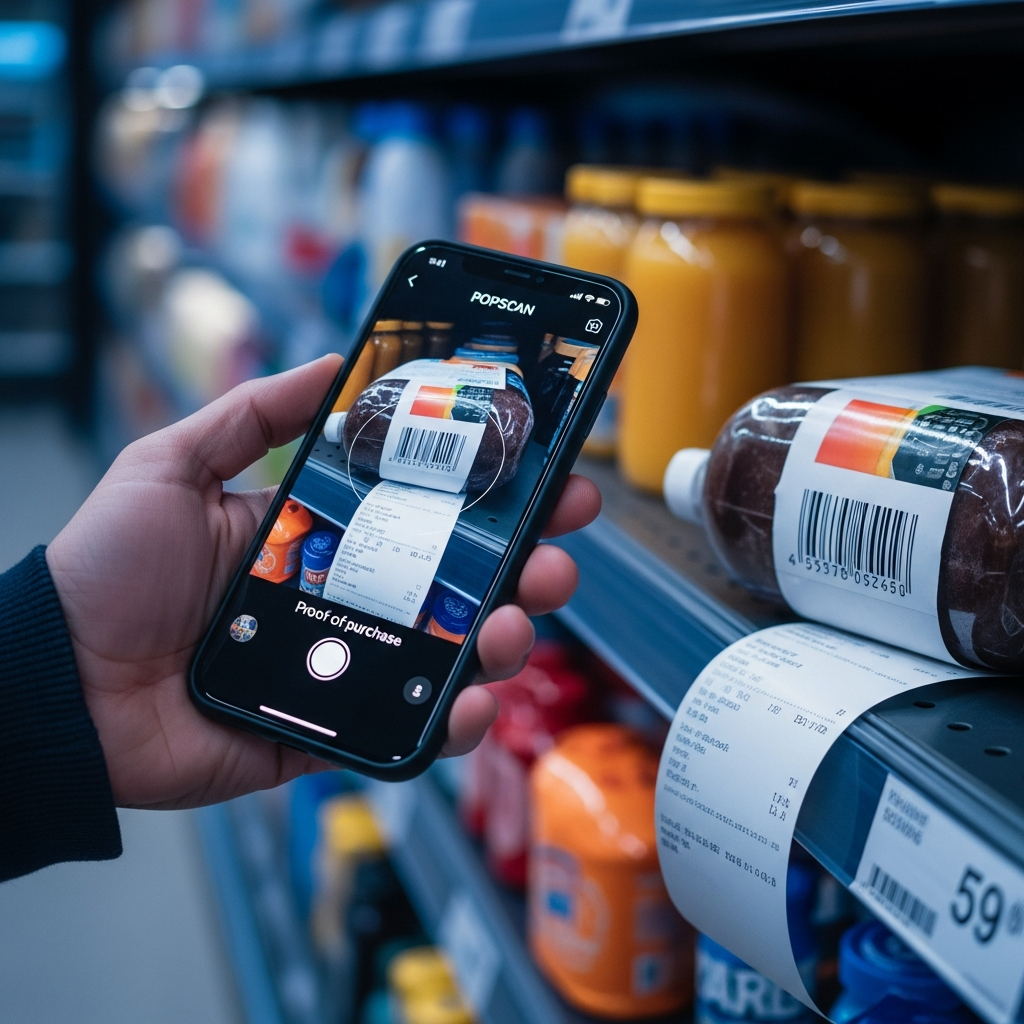
A surprising number of promotion failures start with a document that looks perfectly ordinary. A receipt is cropped a little too tightly, a barcode belongs to the right brand but the wrong SKU, or a claim arrives inside the valid window yet still doesn't add up when the basket is reviewed. That's where many teams lose time and margin, because weak-claim handling often gets treated as customer service clean-up rather than commercial design. I'd argue that's backwards. A strategy that cannot survive contact with operations is not strategy, it is branding copy.
As the UK promotions market leans harder on retail partnerships, loyalty mechanics and fast-turn activation, proof of purchase verification has shifted from back-office admin to core campaign infrastructure. The practical question isn't whether to add controls, but which ones protect participation quality without turning a simple claim into an endurance test. POPSCAN, built by Holograph, is worth a closer look here because its workflow combines product, barcode, and receipt evidence in one auditable path, rather than forcing teams to choose between speed and scrutiny.
Quick context
Weak claims rarely arrive with a polite label attached. In FMCG and retail promotions, they tend to show up as small inconsistencies under volume: duplicate receipt patterns, non-matching products, unclear store formats, delayed submissions, or entries that technically pass one rule while failing the wider promotional logic. The market movement matters. More campaigns now spread across Tesco, Co-op, convenience channels and direct-to-consumer routes at once, which means receipt structures vary more, image quality varies more, and operational teams face more exceptions.
That variation is not abstract. In Holograph work, named campaign examples make the point. The Get Pro Coupons campaign across Tesco and Co-op reported a 43% uplift in email sign-ups, which is commercially useful, but any sign-up or reward mechanic that scales response also scales review pressure. The right lesson is not to tighten everything indiscriminately. It is to design evidence rules that target risk where it actually appears. By the same token, Holograph and ARize reported a 32% sales uplift for Lucozade Energy's Halo Galaxy activation, and ARize with Holograph reported Ribena's Monopoly campaign overshot its entry goal by 258%. Strong participation is good news right until the checking model falls behind the marketing model.
There's a regulatory dimension as well. The ASA has repeatedly warned on misleading prize draw mailings where win implications or key conditions are not made sufficiently clear. Different format, same principle: if the route from entry to claim is vague, trust drops and complaints rise. Clear, auditable consumer journeys matter, especially when the offer depends on a qualifying purchase rather than simple registration.
One more signal is worth folding in. According to the Office for National Statistics, UK well-being datasets continue to track anxiety and satisfaction measures at national and local-authority level, which tells you something practical about the operating environment in 2026: consumers do not have much patience for avoidable friction. If a claim journey feels opaque or unfair, they are unlikely to give you the benefit of the doubt.
Step-by-step approach
The sensible route is to stack controls in the order consumers naturally experience them. In a strategy call this week, we tested two paths and dropped one after the first hard metric came in. The first path front-loaded every check, which looked tidy on paper. The second accepted the claim quickly, then applied proportionate review logic behind the scenes. I liked the first option, but the evidence favoured the second once the numbers landed. Completion holds up better when the first submission step is simple.
For most UK FMCG and retail campaigns, the working sequence looks like this:
| Stage | What to check | Why it matters | Operational constraint |
|---|---|---|---|
| Entry capture | Basic claimant details, clear upload prompts, date window | Reduces avoidable submission errors at source | Too many mandatory fields suppress completion |
| Receipt review | Retailer name, purchase date, line items, total format, duplication signals | Confirms the transaction is plausible and in period | Receipt formats vary across chains and franchise estates |
| Barcode match | EAN or SKU alignment with eligible products | Stops valid-looking receipts supporting the wrong item | Packaging changes and range extensions create exceptions |
| Product evidence | Pack image where risk is higher or campaign value justifies it | Adds confidence when receipt text is weak or abbreviated | Image quality and consumer effort can slow the journey |
| Decisioning and audit | Pass, fail, or manual review with stored rationale | Creates a defensible record for customer operations and compliance | Manual queues need service-level discipline |
This is where barcode and receipt controls earn their keep. A receipt alone can confirm that money changed hands, but not always that the qualifying product was bought. A barcode alone can prove the product exists in your range, but not that it was purchased in the right place and time. Product imagery helps when receipt descriptors are vague, especially in convenience or multi-buy environments. The better option set is combined evidence, applied proportionately.
POPSCAN is designed around that logic. Rather than asking operations teams to inspect isolated files one by one, the workflow connects receipt data, barcode rules and product evidence into a single decision trail. That matters commercially because the gain is not just fraud reduction. It is campaign pace. If claims can be cleared quickly, rewards move on time, support tickets ease, and the promotion does not become its own bottleneck.
A useful tangent here: teams often ask whether AI-generated fake receipts mean every campaign now needs maximal scrutiny. Probably not. Cheap image tools do raise manipulation risk, but the answer is not blanket friction. The answer is calibrated review based on reward value, expected claim volume and known channel variance. A £1 coupon mechanic and a high-value prize claim should not carry the same burden of proof.
Pitfalls to avoid
The most common mistake is treating all weak claims as fraud. Some are simply messy evidence produced by real shoppers in real stores. Sunderland's cold snap this week, recorded at 0°C with patchy drizzle by national weather signals on 15 March 2026, is a reminder that people do not stand in car parks composing pristine receipt photography. They take hurried photos, often under poor light, with packaging half in shot. If the control design assumes studio conditions, rejection rates will climb for the wrong reasons.
The second mistake is relying on a single proof source. A plan looked strong on paper, then one dependency moved, so we re-ordered the sequence and regained momentum. That happened because a receipt-only model began to struggle once store variation widened. Fast-growth retail estates, local promotions and limited editions all increase the odds that one evidence source becomes unreliable on its own.
The third is weak consumer communication. According to ASA guidance on prize promotions, brands should avoid overstating win likelihood and should make significant terms easy to find and understand. The same applies to eligibility evidence. If your mechanics require a whole receipt, the consumer should know that before they upload one corner of it. If barcode visibility matters, say so plainly. Fairness should feel auditable, not theatrical.
There is one honest gap in certainty. No team can remove all edge cases without hurting conversion. As it stands, there is always a tension between clean automated decisions and the cost of manual intervention. The job is to place that tension where it does least commercial harm.
Checklist you can reuse
If you are reviewing a new promotion or repairing an existing one, this checklist tends to surface weak-claim exposure quickly:
- Define the qualifying purchase in terms a shopper can understand in under 20 seconds. Include pack size, retailer scope and date window.
- Map the minimum evidence needed for low, medium and high-risk rewards. Do not ask for three proofs where two will do.
- Test receipt variance using real samples from major chains and convenience formats before launch, not in week two.
- Check whether product naming on receipts actually matches the eligible range. Abbreviations are often where false passes start.
- Set duplicate logic for receipts, claimants and barcodes, with a manual review route for plausible household overlap.
- Store pass, fail and exception reasons in an audit trail customer operations can retrieve quickly.
- Make the claim path visible from entry to outcome. If a consumer has to guess what happens next, complaints usually follow.
For teams under pressure, one argued judgement: park growth claims unless the baseline evidence is there. If your approval rates, exception rates and average handling times are not measured, then claims about improved integrity are just decoration. The commercial implication is immediate. Within the first two to four weeks of a live promotion, those baselines tell you whether to tighten rules, expand manual review, or simplify prompts to recover completion.
Closing guidance
The market is moving towards faster, broader, more fragmented promotions, and that makes weak-claim signals easier to miss until volume exposes them. The practical advantage goes to teams that design integrity early, using proportionate checks and an evidence trail that operations can actually live with. Receipt checks, barcode rules and product confirmation each solve different problems. Used together, they improve decision quality without forcing every genuine claimant through unnecessary friction.
If your current process depends on heroic manual review or vague terms doing too much work, it is worth fixing before the next campaign spike arrives. POPSCAN gives brand activation, fraud and customer operations teams a cleaner route to campaign integrity design that still respects the consumer journey. If you want to pressure-test your current promotion against these weak-claim signals, contact Holograph to review where your controls are too loose, too heavy, or simply in the wrong order.
If this is on your roadmap, POPSCAN can help you run a controlled pilot, measure the outcome, and scale only when the evidence is clear.